Thursday, November 18, 2010

#33 Billy Herman


William Jennings Bryan Herman was born in New Albany, Indiana in 1909, and broke in with the Chicago Cubs in 1931, where he became a fixture at second base for many years to come. He batted .314 in his first full season as the Cubs won the 1932 pennant. 1934 was the first of 8 seasons that saw Herman selected to the National League All-Star team, and he was one of the most reliable players in the senior circuit. In 1935, he had a league-best 227 hits and 57 doubles as the Cubs rolled to another pennant, but lost the World Series again.
By 1940, Herman's numbers began to wane, and he saw himself traded to the Brooklyn Dodgers for Charlie Gilbert and John Hudson. Aided by a depleted talent pool due to World War 2, Herman rebounded in 1943 to hit .330 (2nd in the NL) but next season, at age 34, he joined the military and missed 1944 and '45.
At 36 years of age, it was unexpected that Herman would return from the war as a player, but he played most of 1946, splitting time between Brooklyn and the Boston Braves, playing second, third and first base. He batted a respectable .298. He was traded to Pittsburgh before the 1947 season, and was named player-manager, although he played in only 15 games hitting a paltry .213. He was also relieved of managerial duties before the end of the season as the Pirates went 61-92 under his leadership. It was not his last day on the bench, but his days at the plater were over. His career totals include a lifetime .304 average and over 2300 hits.
Herman moved on to manage in the minor leagues for a few seasons, until he was brought on by the Dodgers as a coach in 1952, followed by the Milwaukee Braves in 1958. In 1960, he became the third base coach for the Boston Red Sox, and in 1964, was named the Red Sox manager for the last two games of the season as the Sox fired Johnny Pesky. The Red Sox fared no better under Herman in 1965, as they lost 100 games and the Sox finished in 9th. Herman was fired partly through the 1966 season.

Billy Herman was elected into the Baseball Hall of Fame in 1975 by the Veterans Comittee. He died in 1992 of cancer.

The Autograph: Herman was a regular through-the-mail signer, as well as a frequent signer at Hall of Fame ceremonies, spring training and conventions. His autograph is very common.


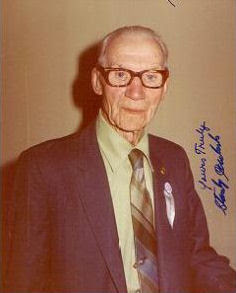
Herman at the 1986 HOF Ceremony

Wednesday, September 1, 2010

Where You Been?

I am not dead, but my scanner is.

But I will return.

Wednesday, May 12, 2010

#32 Terry Moore


Terry Moore was born in 1912 in Vernon, Alabama. Like many Cardinals of his generation, he moved his way through the Cards' farm system and became a member of one of the more notable outfields in baseball history. Teaming with Hall of Famers Stan Musial and Enos Slughter, Moore was a decent hitter as well as an outstanding defensive player.
Moore hit his stride in 1939, batting .294 while being named to the NL All-Star team for the first of four consecutive years. He batted a cumulative .295 from 1939-1942, with 46 home runs, before heading off to fight in the war.
Like so many other players, Moore returned from the World War 2 a shell of player he was. He hung around until 1948, when St Louis released him. He finished with a .280 lifetime average and 1318 hits.
Moore got his chance to manage in 1954, when he took over the Phillies half-way through the season. Replacing Steve o'Neill, the Phils went 35-42 under Moore, and he was replaced by Mayo Smith in 1955. Moore died in 1995.
Not much is written about Moore, at least nothing outside statistical analyses. I did find this sweet pic shown below of Moore modeling an early prototype of a batting helmet. It is hard to be remembered as a good outfielder when you are outshined by the other two outfielders who happen to be great (just ask Davy Jones, Bob Meusel or Duffy Lewis).
The Autograph: In the late 80's and early 90's, Moore enjoyed a resurgence in the hobby as he attended autograph shows along with Stan Musial and Slaughter. He was also one of the first non-HOF or non-HOF-caliber players I wrote to who charged for his autograph. I begrudingly paid the fee for this card.

Thursday, April 22, 2010

#31 George Kelly


George "Highpockets" Kelly was born in 1895 in San Francisco, California. A survivor of the 1906 Earthquake, Kelly was a big fan of the Bay City's PCL club, the Seals. This was an inspiration as he played baseball frequently in his childhood. As a 6'4 teenager, Kelly quickly moved ahead of his classmates, and his natural hitting ability caught the attention of semi-pro clubs around Frisco and Oakland. Fresh out of high school, Kelly signed with Victoria in the NorthWest League in 1915 and quickly caught the attention of John McGraw, manager of the New York Giants. The Giants bought his contract and he was called up to the Giants for a look in late 1915.
After poor performances in limited action for the Giants in 1915 and 1916, Kelly was waived by the Giants shortly into the 1917 season. He was picked up by the Pirates, but faired no better and was let go. McGraw decided to give Kelly another chance, and signed him and sent him to Rochester for the remainder of the 1917 season. Kelly was called on to fight in World War One, and missed the 1918 season. Upom his return to Rochester in 1919, Kelly made the most of his time there and tore up the International League, hitting .356 and 15 home runs. He was poised to return to the National League, but it took a dirty player for him to get his chance.
Hal Chase was the full-time first sacker for the Giants in 1919, and was regarded at the time as the best defensive first baseman the game had ever seen. Chase was no slack at the plate. However, his skill on the field was no match for his lack of moral fiber. Rumors had been floating for years that Chase's ability was "for sale" and was willing to make some side money by throwing games. Rumors had been flying about Chase's corruption as early as 1910. By 1919, the stink surrounding Prince Hal had grown strong, and McGraw called up Kelly to be groomed as Chase's replacement. Kelly responded by hitting .290 in 32 games. After the season, the National League President received an envelope from an anonymous contact, showing a payment from a gambler to Chase to throw a baseball game in 1918. The Giants terminated Chase's contract, and Chase never played in the Major Leagues again.
Kelly became the Giants full-time first baseman in 1920, and lead the league in RBI. He followed that up with a home-run title in 1921, helping the Giants to their first of 4 straight pennants. For the next six seasons, Kelly was the best first baseman in the National League, and one of the game's premier sluggers.
After the 1926 season, he was traded to the Cincinnati Reds for Edd Roush. Although his power numbers were off, mostly due to the change of parks, Kelly still batted around .300 over the next four years, splitting 1930 with the Reds, Cubs, and Minneapolis in the International League. He spent 1931 in the minor leagues, before returning to the National League in 1932, this time with the Brooklyn Dodgers. He was released by the Dodgers following the close of the season, and Kelly headed back west. He played sparingly with the Oakland Oaks of the PCL in 1933 before hanging his glove up for good. Kelly finished his 16-year career with a .297 lifetime average and 1020 RBI.
Kelly bounced around the National League for the next 14 years, picking up coaching jobs for old friends, and after that became a scout for the Reds. He lived in retirement in Millbrae, California. Kelly was elected to the Baseball Hall of Fame in 1973, and died in 1984 at the age of 88.

Kelly is often maligned as being one of the worst Hall of Fame selections. Sometimes I think that members of the Veterans Committee thought they were voting for third baseman George Kell (a deserving candidate). He may be one of the weakest selections, but the thing that annoys me most about Kelly being in the Hall of Fame is that he is often posted as the argument for other non-HOF caliber athletes to be inducted (see Hodges, Gil). It is not worth my typing to discuss Kelly's Hall of Fame credentials (or lack thereof). He is in, and he is never getting out. Let's not repeat the mistake by letting in other not-quite-qualified players. Oops. We already did (See Rizzuto, Phil).

The Autograph: Always a great signer. I don't have a lot of Kelly because he died early in my hobby.

#30 Larry French


Larry French was born in 1907 in Visalia, California. He joined the Pittsburgh Pirates in 1929, and from there embarked on a long and successful career, becoming one of the the top lefthanded pitchers in the National League in the 1930's.
After a 7-5 record in his rookie season in '29, he became a mainstay in the Pirates rotation, winning 17 and 15 games before attaining two 18-win seasons in 1932 and 1933. After slumping to 12-18 in 1934, he was traded to the Cubs where his career was resurrected. With a pennant-winning team, French went 17-10 with a 2.96 ERA, but lost two games in the World Series against the Detroit Tigers. He followed that up with an 18-9 record in 1936 and 16-10 in '37.
After a few more solid seasons for the Cubs, French was traded to the Dodgers near the end of the 1941 season. In 1942, at 34 years of age, French went 15-4 with a 1.83 ERA (7 innings shy of qualifying for the league lead) in time split between the bullpen and the rotation.
Following the 1942 season, French found beginning of a new career and a new calling. Already a member of the Navy Reserve Corps, French joined the Navy full-time and never again appeared on the diamond. He won 197 games in his career, and threw over 3100 innings.
French saw action in the D-Day invasion of Normandy in June of 1944, and also found himself in the Okinawa invasion the following year in the Pacific. He was released from active duty in late 1945, and contemplated returning to baseball to get those three wins he needed to get 200, but decided against it. He stayed in the Naval Reserve, and in 1951 he was recalled when the Korean War erupted. After the Korean War, he remained stationed in San Diego, and in 1965 was promoted to Commanding Officer. He retired from the Navy in 1969, and lived in San Diego the rest of his life, playing golf and squash, as well as gardening with his wife, Thelma. French died in 1987 at 79 years of age, and is the only man in baseball history to have served ten years in both the military and Major League baseball.

The Autograph: There was a stretch where French stopped responding to autograph requests through the mail, but not when I got this card signed.

Sunday, March 14, 2010

#29 Stan Coveleski


Born Stanislaus Kowalewski in 1889 in the heart of anthracite country, Stan Coveleski spent his early teen years in the coal mines near Shamokin, Pennsylvania. Working 12 hours a day, six days a week, Coveleski's only recreation during his off-time was throwing rocks at tin cans. After a while, he said, he got so good he could do it blindfolded. When the local school's baseball coach heard about his skill, they asked him is he would like to exchange the rock with a baseball. He was one of five brothers born to his Polish-born parents, four of which played professional baseball. The oldest, Jacob, was killed in the Spanish-American War in 1898. Frank pitched some before rheumatism ended his career. John was a third baseman and an outfielder who never made it out of the minor leagues. That leaves Harry and Stan. Harry Coveleski shaped the 1908 National League pennant race. While with the Phillies, he beat the Giants three times in the last 8 days of the season, probably more at blame for the Giants pennant swoon than Fred Merkle's legendary base-running gaffe. Harry wound up winning 20 games three times for the Tigers in the early 1910's.
After playing around Shamokin, Stan signed with Lancaster in 1909 for $250 a month, a nice raise from his current job of cutting timber, which paid $40 a month. He went 23-11 in his first season with Lancaster, hurling 272 innings. In 1912, he moved to Atlantic City, and his 20 wins there caught the attention of Connie Mack of the Philadlphia Athletics. After a short stint with the Athletics, who had a deep pitching staff at the time, Coveleski was sent to Spokane (Wash.) in the Northwest League for some seasoning. In 1914, Coveleski wa traded for five players to Portland in the PCL. It was in Portland that Coveleski learned a new pitch, a pitch that would make him a Hall of Famer.
Already armed with a good fastball, curve, and off-speed pitch, Coveleski began to fool around with the spitball. The "spitball" is a generic term for a pitch where the ball has been doctored. That can be either a substance used to change to grip or rotation, or scuffed up to get different breaking action. This type of pitch was very legal in the early days of the sport, and those that mastered it counted on it as much as any other "out" pitch. And Coveleski quickly developed one of the best the game has ever seen. He tried out with tobacco juice first, but Iron Joe McGinnity, a spitballer who won an American League record 41 games for the New York Higlanders (aka Yankees) in 1904, suggested he use alum instead. Coveleski kept alum in his mouth while on the mound, and the gummy residue gave his ball some action that was incredibly difficult to hit.
After the 1915 season in Portland, Coveleski was sold to the Cleveland Indians, where he won 15 games in 1916. He won 19 games in 1917, and 1918 was the beginning of four-straight seasons of at least 22 wins.
In 1920, the Indians were set to be in a season-long battle for the pennant. The New York Yankees were in the thick of things for the first time, thanks to their newest acquisition, Babe Ruth. The Chicago White Sox were as good as ever, for most of the team was inspired by the defeat in the World Series before and the rumors that the 1919 Series had been fixed. But the Indians overcame a series of tragedies to win their first pennant and World Championship in one of the greatest pennant races ever.
Cleveland Indian shortstop Ray Chapman was killed in August when a Carl Mays pitched struck him in the head, fracturing his skull. As bad as that was, for Coveleski, it was only an additional event to an already sad season. In May of that year, his wife Mary had died suddenly. Although she had been ill, her health had not deteriorated to where her death was expected. He left the team for a week before returning.
That year Coveleski won 24 games with a heavy heart, while Jim Bagby won 31. That one-two punch carried the Indians to the World Series, but it was Coveleski who was the hero. Coveleski won three games in that World Series, going the distance in all three games he pitched. Only Mickey Lolich has thrown three complete game World Series wins since (1968).
Prior to the 1920 season, the rules of baseball were modified and the spitball was banned. However, 17 pitchers who relied on the pitch were permitted to through the pitch that season, to give them a chance to adapt their skills to other pitchers. However, after the season, it was decided that rather than force these guys to change their abilities, they were allowed to throw the pitch for the remainder of their career. When Burleigh Grimes retired in 1934, he was the last man to legally throw a spitball in the major leagues.
Coveleski's career showed a slight decline after 1921, and after a mediocre season in 1924, Coveleski, now 35, was traded to the Washington Senators. He rebounded in 1925, going 20-5 with an AL-best 2.84 ERA, but the end of the road was quickly approaching. After two more seasons of decline, he was released by the Senators in 1927. He signed with the Yankees and pitched briefly in 1928, but upon his release was the end of Coveleski's days on the mound. He won 216 games in a career that essentially began at 26, with a .602 winning percentage.
Now re-married, to his deceased wife's sister Frances, Coveleski moved his family to South Bend, Indiana. He owned and operated a gas station there, and bought a house that he would live in for over 50 years. The gas station failed in the Depression, so Coveleski retired and would spend the remainder of his days fishing and hunting.
He was elected into the Hall of Fame in 1969, and was a fixture around South Bend. He fell ill with cancer in the early 1980's, and succumbed to the disease in March of 1984, at 94 years of age.

I am a big fan of Stan Coveleski. I was able to write him in the waning years of his life, and also corrosponded with his son, Bill, after Stan's death. Unfortunately, Bill himself died not long after Stan did. A lot of things draw me to Stan. I admire his blue-collar work ethic and his skill. Like him, I am of Polish ancestory, and there are Kowalewski's in my family bloodline, and both our families came over to the in a similar era. Anyone I talk to who knew him say he was exactly what you hope your favorite athelete would be like. He always signed autographs, answered questions, and loved to talk about the game, although he was also quiet and stoic. Bill told me that even as the cancer got really bad, on his good days he would just sit and sign Hall of Fame postcards by the dozens in case he is unable to sign future autograph requests, or in case he gets fan mail after his death. I regret not writing him earlier, he really sounded like an interesting man.

The minor league park in South Bend is named for Coveleski. Known as the "The Cove," the home of the Silver Hawks is the grandfather of the modern ballpark, designed by the same architectural firm that has done Camden Yards and Jacobs Field.

The Autograph: His autograph is in good supply. I have a lot in my collection. This card, among many others. I have Hall of Fame Postcards, photographs, even a signed baseball.

Below is the Lancaster team, circa 1909. Coveleski can be seen in the top row, fourth from the left.

Covey at the Hall of Fame

Wednesday, March 3, 2010

#28 Charlie Gehringer


Charlie Gehringer was born in 1903 in the small farming community of Fowlerville, Michigan. He attended the University of Michigan for a year, before being spotted by Detroit Tiger's former outfielder Bobby Veach, who recommended his friend and Tiger manager Ty Cobb sign him. Gehringer left school and in 1924, made his debut with the Tigers after some time in the Michigan-Ontario League. He returned to Toronto in 1925, despite hitting well in his late-season call-up in 1924. By 1926, he joined Detroit to stay.

Over the next 15 years, Gehringer set the standard for second basemen in the American League. After hitting .277 in his first full season in 1926, he hit .300 or better in 13 of the next 14 seasons, with the exception being .298 in 1932. Teaming with Bill Rogell at shortstop, Hank Greenberg at first and Marv Owen at third, he was part of the best infields in major league history, leading the Tigers to two pennants in 1934 and 1935. That infield alone knocked in a record 462 runs in 1934. Gehringer had 60 doubles in 1936, and won the AL batting title (with a .371) and the leagues MVP award in 1937. In 1940, he hit .313 and lead the Tigers to a third pennant in 7 years.
In 1941, at age 38, his numbers dropped off dramatically and after a 1942 season that saw him hit a mere .267, Gehringer decided to join the army. He came from the war in fine physical condition, and toyed around with rejoining the Tigers to try to get the 161 hits he needed to reach 3000, but decided against it. He finished his career with a .320 average and .490 slugging percentage.
Gehringer's life to this point was two things: baseball and his mother. His mother, widowed when Gehringer was young, was in poor health with diabetes and needed someone to look after her, which Gehringer gladly did. This meant Charlie was a bachelor through his playing days, but when his mother passed, Gehringer finally met his bride-to-be, and they were set to wed in 1949. Gehringer was also elected to the Baseball Hall of Fame in 1949, and the induction ceremony was five days before his planned wedding. Rather then tempt fate and allow something to happen while travelling that could delay or postpone his nuptials, Gehringer chose to skip the induction in Cooperstown and stay home to prepare for the wedding. To make up for his absense, Gehringer would be in attendance at every Induction for the next 40 years.

In 1951, Gehringer became the general manager of the Tigers, a position he held through 1953 before resigning. He returned to work full time for his own company, which manufactured fabrics used on automobile seats. He ran the company until selling his interest in 1974. He died in January of 1993 at the age of 89 following a stroke.

He also owned a gas station in Detroit in the 30's.


Much has been written about Gehringer's quiet personality and robot-like skill. He is also one of those guys you never hear a bad word about from anyone. He was always kind and polite, and kept to Teddy Roosevelts credo about walking softly and carrying a big stick. Satchel Paige said he was the toughest out he ever faced, and Bill Rogell told this blogger that Charlie was the kind of guy you wanted all your friends to be like. I remember very well the day he died, and the tributes poured in to the local media from all around even though lots of his contemporaries had already passed. He is on the short-list of great second basemen, along with Collins, Hornsby, Morgan, Alomar....

I knew a girl who was related to Gehringer. She was like a second cousin or something... not close enough to be in the will, but not too distant to have not met him on several occasions. I always thought that was cool be related to ballplayer. I used to tell people I was related to Nemo Leibold. However, since A) my last name is not Leibold and B) no one knows who Nemo Leibold is, no one seemed to care and it did not get me any closer to hooking up with chicks, which is one of the only two reasons to lie in life (the other is money). Maybe being related to Nemo would have got me in with the Gehringer chick, but she kinda looked like Charlie, so with all due respect to the Mechanical Man, I don't look at that as a missed opportunity.

The Autograph: Gehringer has one of the nicest autographs in sports history. Even in age, it stayed nice and steady. He must have passed his penmanship skills on to Rick Ferrell, because you can see similarities in the two.


Gehringer, Kell, Greenberg, Harwell, Kaline